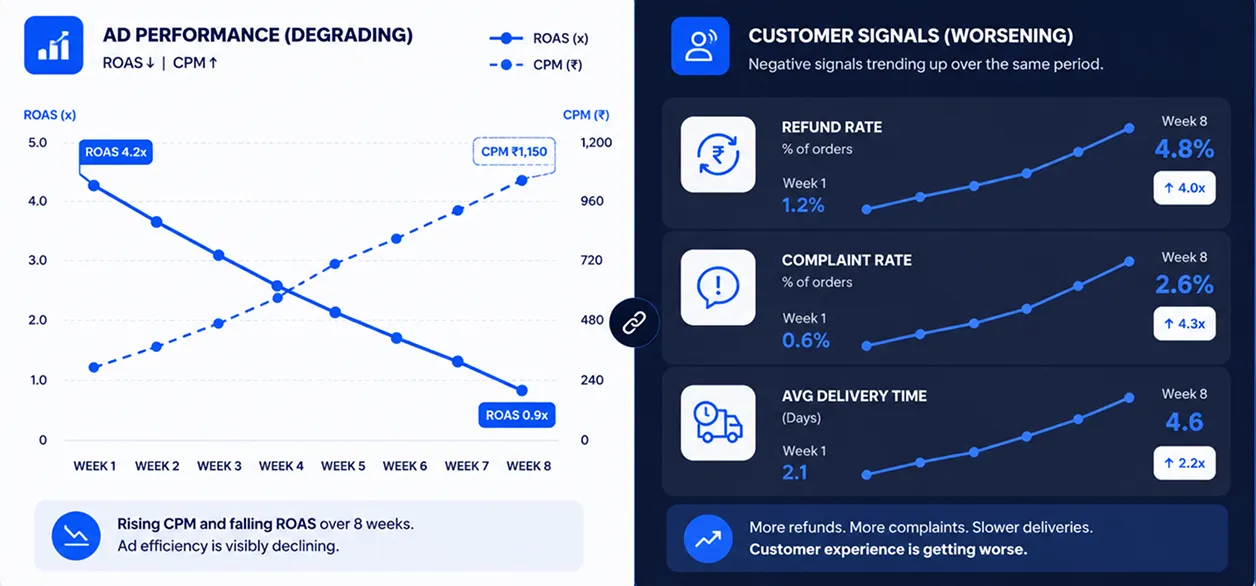
CPMs crept up on accounts that used to be cheap — same audiences, same creative.
CPA inflated and stayed there, even after you rebuilt campaigns.
ROAS slid over a few weeks with no clear reason in the data.
Delivery got unstable — spend won't pace, learning won't exit.
Ads, pages, or accounts started getting rejected or restricted more often.
It all started after a rough patch: a bad batch, a shipping delay, a refund wave, a flood of unhappy customers.
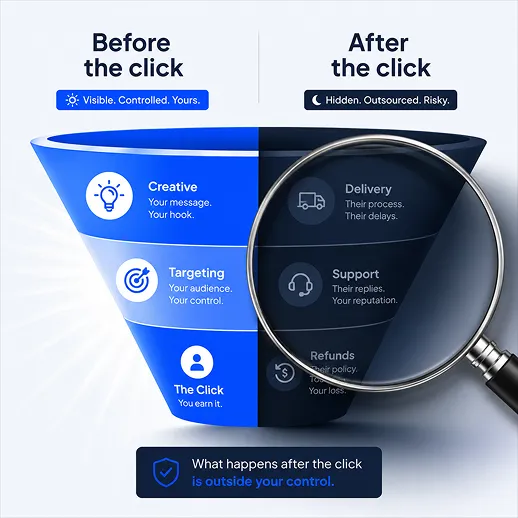
When ad performance drops, the instinct is to tweak creatives or bids. But Meta also tracks what happens after the click.
Poor post-purchase experiences—like shipping backlogs or bad product batches—feed negative signals back to your account. The invisible results?
It’s the most overlooked variable in performance drops because you won't see it in Ads Manager.
When Meta ad performance drops, the instinct is to tweak creatives or bids. But Meta also tracks what happens after the click, surveying your buyers to build a hidden "business quality signal"—essentially a credit score for your customer experience.
When shipping delays or product issues trigger negative feedback, Meta quietly penalizes your account with:
Because this metric is completely invisible inside Ads Manager, most brands have never audited it. You can't manage what you can't see—and that is the exact gap we close.
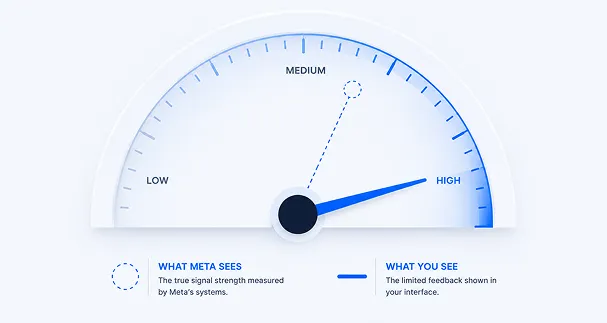
Some people say "feedback score is dead" because Meta stopped showing page scores publicly the way it once did. The public number changed. The underlying customer- experience signals did not go away. They just got harder to see — which makes auditing them more valuable, not less.
Almost every signal problem we audit traces back to one of these — and they're all things a high-volume store hits eventually.
Some people say "feedback score is dead" because Meta stopped showing page scores publicly the way it once did. The public number changed. The underlying customer- experience signals did not go away. They just got harder to see — which makes auditing them more valuable, not less.
One bad supplier batch, a quality drop, a product that doesn't match the ad or the photos. The refunds and complaints cluster fast, and the damage can outlast the batch itself — the signals linger after you've already fixed the product.
Slow or absent support, unanswered DMs, a refund spike, customers who feel ignored. Unhappy customers who can't reach you don't stay quiet — they leave feedback elsewhere, and that experience is part of what Meta is measuring.
A structured process — not a one-off hack that wears off in two weeks.
We review your account signals, recent performance shifts, refund and complaint patterns, fulfillment timelines, and support flow to map where your customer signals may be weakening.
We identify the most likely root cause behind your performance shift and separate genuine signal problems from ordinary media issues, so you don't waste spend solving the wrong thing.
We give you a prioritized action plan to repair the customer-experience leak at the source and, where appropriate, the account-level steps to support recovery.
Signals drift. We set up ongoing monitoring so a future bad batch or shipping wave gets caught early — before it quietly eats your ROAS again.
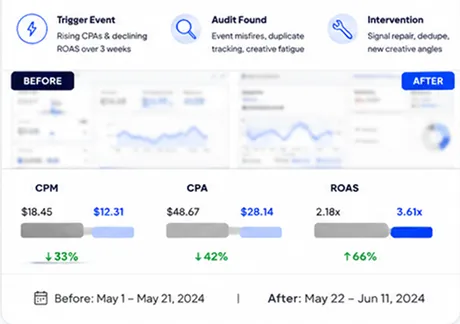
Anonymized before/after snapshots: brand category + spend tier, the trigger event, what the audit found, the intervention, and the directional change in CPM/CPA/ROAS over a stated window. Always with the honest caveat that no single factor explains all performance movement.