


Your creatives are strong. Your targeting is dialled in. Your funnel converts. And yet something is wrong — CPM is creeping up, delivery is inconsistent, scaling hits a wall you cannot explain. You test new creatives. Nothing changes. You expand audiences. Still nothing. You restructure campaigns. Same result.
The problem is not in Ads Manager. It is underneath it.
Meta operates an internal scoring system that evaluates every advertising account, every page, every Business Manager — continuously, invisibly, and with real consequences for ad delivery, costs, and scaling potential. Most advertisers have no idea it exists in its full form. And since Meta removed the last visible indicator of this system from public view in late 2024, even the small window that once existed into these scores is now gone.
This article explains exactly how Meta's internal signal system works, what it measures, what happens when signals degrade, why the consequences compound over time, and what it takes to diagnose and fix a problem that your own Ads Manager will never show you.
The system most advertisers do not know exists
Meta's advertising platform has two layers. The first is the one you interact with every day — Ads Manager, campaigns, ad sets, creatives, audiences, budgets. This is the layer where most advertisers spend all of their analytical attention. When performance drops, this is where they look.
The second layer is Meta's internal trust and quality infrastructure — a continuous evaluation system that assigns scores to every entity connected to your advertising: your ad account, your Facebook page, your Business Manager, and the business behind all of them. These scores operate independently of your campaign settings. They are not influenced by your creative quality in isolation. They are influenced by the cumulative history of your account — every signal Meta has collected about your business, your customers' experiences with it, and your compliance record over time.
These two layers interact in a way most advertisers never understand: the decisions Meta makes at the internal signal layer determine how effectively the campaign layer can perform. You can have a perfect campaign — right audience, right creative, right budget — and still get poor results if the internal signal layer is working against you. Meta's algorithm allocates delivery, determines auction competitiveness, and sets CPM floors partly based on these internal scores. A healthy account at the internal level competes more efficiently. A degraded account pays more and reaches fewer people, regardless of how good the campaigns are.
The four internal signals that control your performance
Meta's internal evaluation system is not a single score — it is a combination of signals that work together, each influencing the others. Understanding what each signal measures helps explain both how problems develop and how they are addressed.
1. The HiVA score — delivery quality at the asset level
HiVA is Meta's internal score assigned to each advertising asset — your ad account, your page, your Business Manager — to rank its trustworthiness and delivery quality. It is not visible anywhere in the platform. There is no notification when it changes. It does not appear in Account Quality or Business Manager settings.
The HiVA score functions as a delivery quality rating. Meta uses it to determine how efficiently an account's ads should be distributed across its auction system. An account with a high HiVA score competes more effectively — its bids win more high-quality placements at a given spend level. An account with a degraded HiVA score is at a disadvantage in the same auction, even bidding the same amount against the same audiences. The result is higher CPM, lower reach, and reduced delivery efficiency that shows up as unexplained performance decline.
2. The feedback score — still active, now invisible
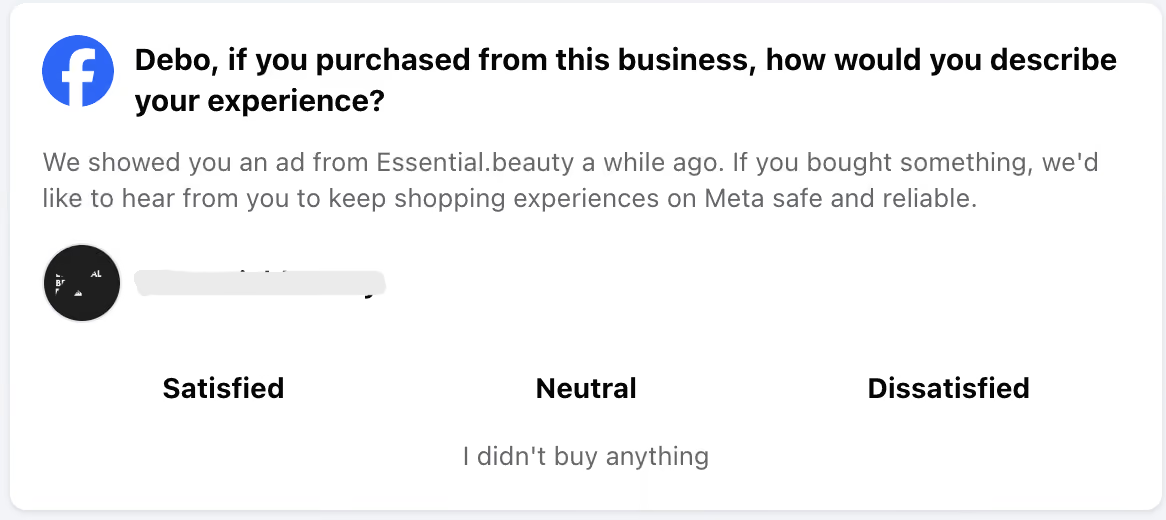
The Facebook feedback score was, for several years, one of the few internal signals that advertisers could actually see. It was a 0–5 rating based on post-purchase customer surveys — measuring product quality, delivery speed, customer service, and overall satisfaction. Accounts with scores below 2 received an official delivery penalty; accounts below 1 lost advertising access entirely. Meta's original feedback score documentation described the system in detail.
In late 2024, Meta removed the visible feedback score from Business Suite and Commerce Manager. As confirmed by multiple sources and Meta's own communications, the score itself was not discontinued — Meta stated it was 'revamping the system.' The surveys continue. Meta continues collecting post-purchase customer feedback. The score continues to be calculated and continues to affect campaign performance. It simply can no longer be seen.
This change created a significant blind spot. Advertisers who had previously monitored their feedback score and taken action when it declined can no longer do so. Businesses that assumed the score was discontinued because it disappeared from the dashboard are operating under a false assumption — one with real performance consequences.
3. The ad account trust level
Separate from the HiVA score and the feedback score, Meta maintains a trust level for each ad account that reflects its compliance history, payment reliability, and behavioural signals over time. This trust level affects how Meta's automated systems treat the account — how many ads can be in review simultaneously, how quickly new ads are approved, what spending levels are permitted, and how much scrutiny is applied to ad content.
The ad account trust level is partially surfaced through Meta's Account Quality dashboard — which shows policy violations, restrictions, and account status. However, the underlying trust score that drives these outcomes is not directly displayed. What advertisers can see are the consequences: higher ad rejection rates, slower approvals, spending limits that tighten despite clean payment history, and restrictions that appear with minimal explanation.
4. The Business Manager reputation score
At the top of the hierarchy, the Business Manager carries its own reputation score that affects everything operating underneath it. Since late 2024 and through 2025, Meta has made BM-level quality indicators more visible — the Account Quality section now shows a broader view of business health including policy compliance across assets. But the underlying BM reputation score that influences delivery and access at the infrastructure level remains internal.
The BM reputation score is particularly important because it creates a ceiling effect: individual assets cannot consistently outperform what the BM's overall reputation allows. An ad account operating under a BM with a degraded reputation score will encounter friction — higher review times, lower delivery efficiency, more conservative spending limits — regardless of how well the individual ad account has been managed.
How you know something is wrong — symptoms of internal signal degradation
Because the internal signals are invisible, advertisers first encounter them as performance anomalies that do not respond to standard fixes. The symptom pattern is distinctive once you know what to look for.
CPM increases with no external cause
The most common and most immediately noticeable symptom is a CPM increase that arrives without a corresponding change in creative, audience, budget, or competitive environment. Seasonality does not explain it. Creative fatigue does not explain it — new creatives produce the same elevated CPM. Audience expansion does not help. The CPM is elevated at the account level, not the campaign level, because the cause is in the account infrastructure, not the campaigns.
A scaling ceiling that appears at a specific spend level
This is one of the most diagnostically significant symptoms and one of the least well understood. An account with degraded internal signals can perform acceptably at lower spend levels — the signals are bad enough to add cost, but not bad enough to prevent delivery entirely. As spend increases and the account pushes into higher-competition auction territory, the degraded HiVA score and trust level become increasingly limiting. Performance deteriorates abnormally past a certain daily budget threshold. The brand interprets this as a scaling problem — perhaps their offer does not work at scale, perhaps their audience is saturated — when the actual cause is that their internal signals cap how competitively the account can operate above a certain spend level.
Increased ad rejection rates
An account with a degraded trust level faces higher scrutiny on new ad submissions. Ads that would be approved quickly on a healthy account are rejected or held in review for extended periods. Creatives that previously ran without issue on the same account are now flagged. This is not a content change — it is a change in how Meta's automated review system treats the account based on its internal trust level.
Delivery throttling across campaigns
Previously stable campaigns begin under-delivering — spending less than the daily budget, reaching fewer people per dollar, failing to exit the learning phase cleanly. This throttling is applied at the account level by Meta's delivery system as a consequence of internal signal degradation. It is invisible in campaign reporting beyond the under-delivery itself.
The snowball effect — how signal degradation compounds over time
Internal signal degradation does not plateau. Left unaddressed, it compounds — through a self-reinforcing cycle that makes the problem progressively worse.
The mechanism works like this: Meta receives negative customer feedback from post-purchase surveys. In response, it increases the frequency of surveys sent to that business's customers — it is actively collecting more data because it has identified a problem signal. As more surveys return negative responses, Meta lowers trust scores and increases the weight it gives to any further negative signals from that account. The account is now under closer scrutiny. Any compliance issue that would have been absorbed by a healthy account — a minor policy flag, a single ad rejection — is now treated more seriously because the account's trust level is already degraded. Each new issue lowers the score further. The scrutiny increases. The performance deteriorates further.
The compounding effect operates across all four signal layers simultaneously. A declining feedback score lowers the HiVA score. A lower HiVA score reduces delivery efficiency. Lower delivery efficiency means more wasted spend and worse campaign metrics. Worse campaign metrics trigger more internal review. The account spends less time in healthy delivery and more time in restricted or penalised states. And throughout all of this, nothing in Ads Manager explains what is happening.
This is why accounts that have been degraded for six, twelve, or eighteen months are significantly harder to restore than accounts where the issue is caught early. The longer the snowball rolls, the more compressed and interlinked the individual signal problems become.
What Meta actually measures — complaint rates by category
The chart below was shared with an advertiser directly by their Meta representative in April 2026. It shows how Meta categorises customer complaints by type and ranks their severity relative to other advertisers. This is insider data that is almost never seen publicly — it reveals exactly which types of negative feedback trigger the most severe internal signal penalties.
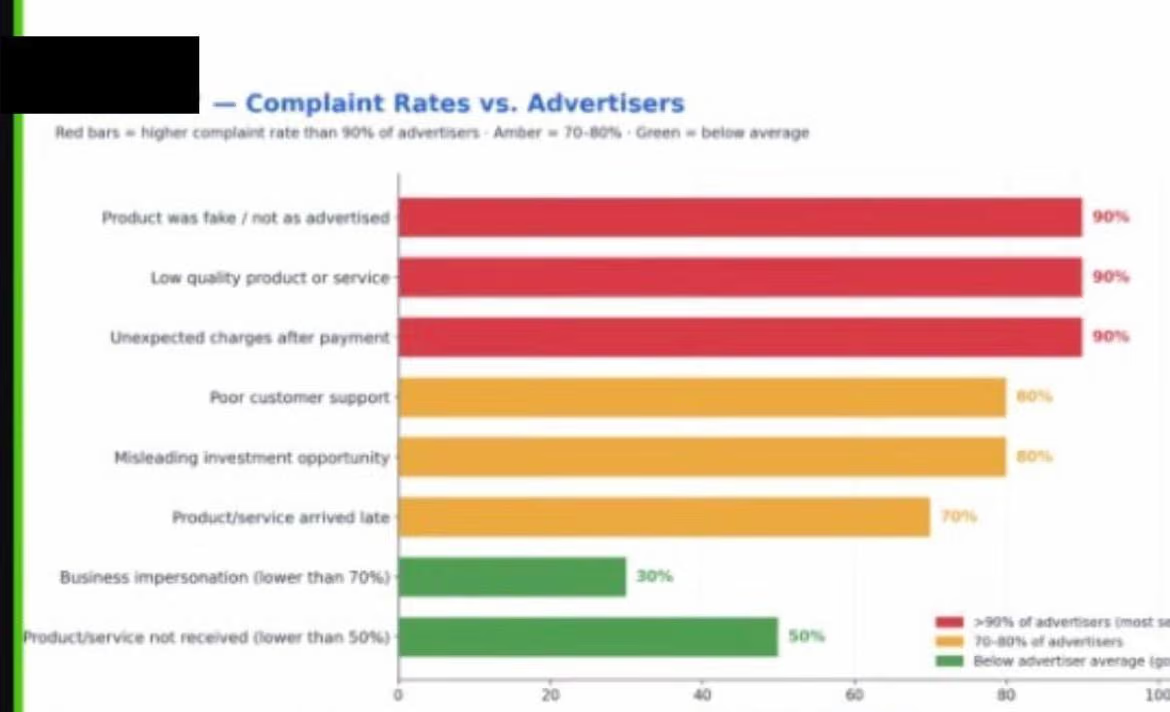
Complaint rates by category shown to an advertiser by a Meta representative — April 2026. Red = higher than 90% of advertisers. Amber = 70–80%. Green = below average.
The hierarchy is clear. The three highest-severity complaint types — product was fake or not as advertised, low quality product or service, and unexpected charges after payment — place an account in the top 90% for complaint rates, meaning worse than 90% of all advertisers. These are the complaint types that trigger the most rapid and most severe internal signal degradation.
Amber-level complaints — poor customer support, misleading investment opportunity, and late delivery — affect 70–80% of advertisers. They are damaging but less immediately critical. Green-level complaints — business impersonation and product not received — are comparatively rare and rank below the advertiser average.
The practical implication: the complaint types that are easiest to generate through dropshipping practices — product not as advertised, low quality, unexpected charges — are also the ones that cause the fastest and most severe feedback score damage. An ecom brand shipping low-quality products, using misleading ad claims, or adding undisclosed charges is not just risking customer dissatisfaction. It is directly accumulating the highest-penalty complaint signals in Meta's internal scoring system.
What you can and cannot see — the visibility picture in 2026
Since late 2024, the visibility into internal Meta signals has become more limited than at any previous point. Here is an accurate picture of what is and is not accessible to advertisers.
What you can see
The Account Quality dashboard in Business Manager shows policy violations, restrictions on specific assets, and account status. It will tell you if an asset is restricted or disabled, and in many cases why. This is genuine information — but it is the endpoint, not the early warning system. By the time something appears in Account Quality as a restriction, the internal signal degradation that caused it has been building for some time.
Within Ads Manager, Meta surfaces three ad-level quality rankings: Quality Ranking, Engagement Rate Ranking, and Conversion Rate Ranking — which show how individual ads compare to others competing for the same audience. These are ad-level signals, not account-level signals, and they measure relative creative performance rather than the underlying account health infrastructure.
Some Business Manager-level indicators of account health are visible — particularly around payment history, identity verification status, and policy compliance record. These are useful hygiene indicators but they do not reveal the HiVA score, the trust level, or the current state of the feedback score.
What you cannot see
- The HiVA score — completely internal, no access for advertisers at any account type
- The feedback score — removed from public visibility in late 2024; surveys still collected, score still active, no longer visible
- The account trust level — internal metric influencing approval rates and delivery; consequences visible, score itself not
- The BM reputation score — internal infrastructure metric; effects visible through delivery and access limitations, score not directly accessible
The practical consequence of this visibility gap is that advertisers cannot diagnose internal signal problems through self-inspection. The data needed to identify that the issue is internal, which signals are degraded, and what is causing the degradation is simply not available in the standard advertiser interface.
What you can fix yourself — and where professional intervention changes the outcome
This is an important question to answer honestly, because the answer determines what action is appropriate for your situation.
What you can genuinely fix yourself
Several of the underlying causes of internal signal degradation are within an advertiser's direct control and can be addressed without specialist help:
- Customer experience and fulfilment quality. The feedback score is driven by post-purchase surveys. Improving delivery speed, product accuracy, customer service responsiveness, and returns handling directly improves the data Meta collects. This is the most important self-serviceable fix.
- Ad compliance. Reviewing ad content against Meta's advertising standards and removing misleading claims, non-compliant imagery, or policy-violating copy reduces the accumulation of rejection signals.
- Account structure. Fixing structural issues — improper asset ownership, missing verification, shared payment methods — removes a category of trust signal problems. Our Facebook ads setup guide covers this in full.
- Monitoring Account Quality regularly. Addressing policy violations and restrictions promptly rather than leaving them unresolved prevents compounding.
Where professional intervention changes the outcome
Self-correction addresses the visible and actionable causes of signal degradation. It does not address the accumulated signal history — the existing degradation in HiVA scores, trust levels, and feedback data that has built up over months of suboptimal performance. Improving customer experience from this point forward improves the new data Meta collects; it does not immediately reverse the existing penalty signals that are already embedded in the account's score.
More significantly, there are dimensions of account health that require specialist knowledge to diagnose at all. Meta's internal systems evolve continuously — the specific signals that are being weighted heavily, the patterns that trigger automated penalties, the strategies that have fallen out of favour with Meta's trust systems — change over time. What was acceptable practice twelve months ago may now be creating low-signal flags that an advertiser following general best-practice guidance would not know to address.
If you are performing adequately and want to maintain that level, consistent compliance and good customer experience is sufficient. If you want to push past a scaling ceiling, recover from prolonged performance decline, or build an account health foundation strong enough to support serious scaling, the details that a professional audit surfaces — the specific technical issues, the historical signal problems, the current penalty patterns — are not visible through self-inspection.
What to do if you suspect your internal signals are degraded
There is no single checklist that covers every situation, because the combination of signals involved and the degree of degradation varies by account. But the diagnostic and remediation process follows a consistent logic.
- Audit your customer experience pipeline first.
Even though the feedback score is no longer visible, Meta is still collecting data through post-purchase surveys. Check your average delivery times against what your ads promise. Review your recent customer service interactions. Look at your refund and return rates. Any significant gap between what your ads promise and what customers experience is creating negative survey data that Meta is using against your account right now. - Review Account Quality for any open issues.
Navigate to facebook.com/accountquality and look for any policy violations, restrictions, or warnings. Address open issues promptly — every unresolved issue contributes to the accumulating negative signal picture. - Check your account structure for the foundational issues.
Verify that assets are owned rather than connected, that verification is complete, that payment methods are clean and separated. A structural audit using our setup checklist covers the main structural vulnerabilities. - If performance does not respond to these fixes, bring in a professional audit.
If you have addressed the visible and self-serviceable issues and performance remains degraded, the cause is in the internal signal layer that requires specialist access to diagnose. This is what our Account Health & Performance Fix service addresses — a complete diagnostic of the account's signal health followed by targeted intervention.
Prevention — building an account that compounds positively instead of negatively
The brands that never experience the performance cliff of severe internal signal degradation are the ones that treat account health as infrastructure rather than as a problem to solve reactively. The preventive measures are not complicated — they are consistent applications of the same principles that make any account resilient.
- Maintain customer experience quality proactively. Treat Meta's invisible feedback collection as an ongoing audit of your business. The surveys your customers are receiving right now are shaping your internal score.
- Build the right account structure from the start. A correctly built account with backup profiles, proper asset ownership, and clean payment setup absorbs problems that a fragile account cannot. See our complete setup guide.
- Use infrastructure that is resistant to signal degradation. Agency ad accounts — genuine ASP-backed accounts — operate under a different trust baseline than standard accounts. They start with higher internal signal health and maintain it through the compliance programme that governs access. For advertisers at serious scale, this infrastructure difference is one of the most impactful investments available.
- Have a professional review your account health periodically. Internal signal health is not static — it changes as Meta's systems evolve and as your business activity generates new data. Periodic professional review catches emerging problems before they compound.






.avif)